
Charleston County Probate Court Records
Charleston County probate court records span more than three centuries, from wills filed in 1671 to estates opened today. The Charleston County Probate Court handles estate administration, wills, guardianship and conservatorship cases, marriage licenses, and involuntary commitments for one of South Carolina's largest and most historically significant counties. The court opens roughly 2,200 estates and issues approximately 5,000 marriage licenses per year. Probate filings are available through the court at 100 Broad Street in downtown Charleston and through state-level repositories for older records.
Charleston County Probate Court Quick Facts
Charleston County Probate Court Location and Contact
The Charleston County Probate Court is located at the Judicial Center at 100 Broad Street, Suite 469, Charleston, SC 29401. The court is open Monday through Friday from 8:30 AM to 5:00 PM. The phone number is (843) 958-5180 and the fax is (843) 958-5191. The court handles three primary divisions: Estate, Commitment, and Marriage. Each division produces its own category of probate court records in Charleston County.
The Probate Judge is elected countywide to a four-year term. The court's stated mission is to deliver essential services and protect the best interests of individuals it serves, with commitments to compassion, integrity, dedication, professionalism, and efficiency. Charleston County's Probate Court has a long institutional history and handles one of the highest volumes of probate filings in South Carolina each year.
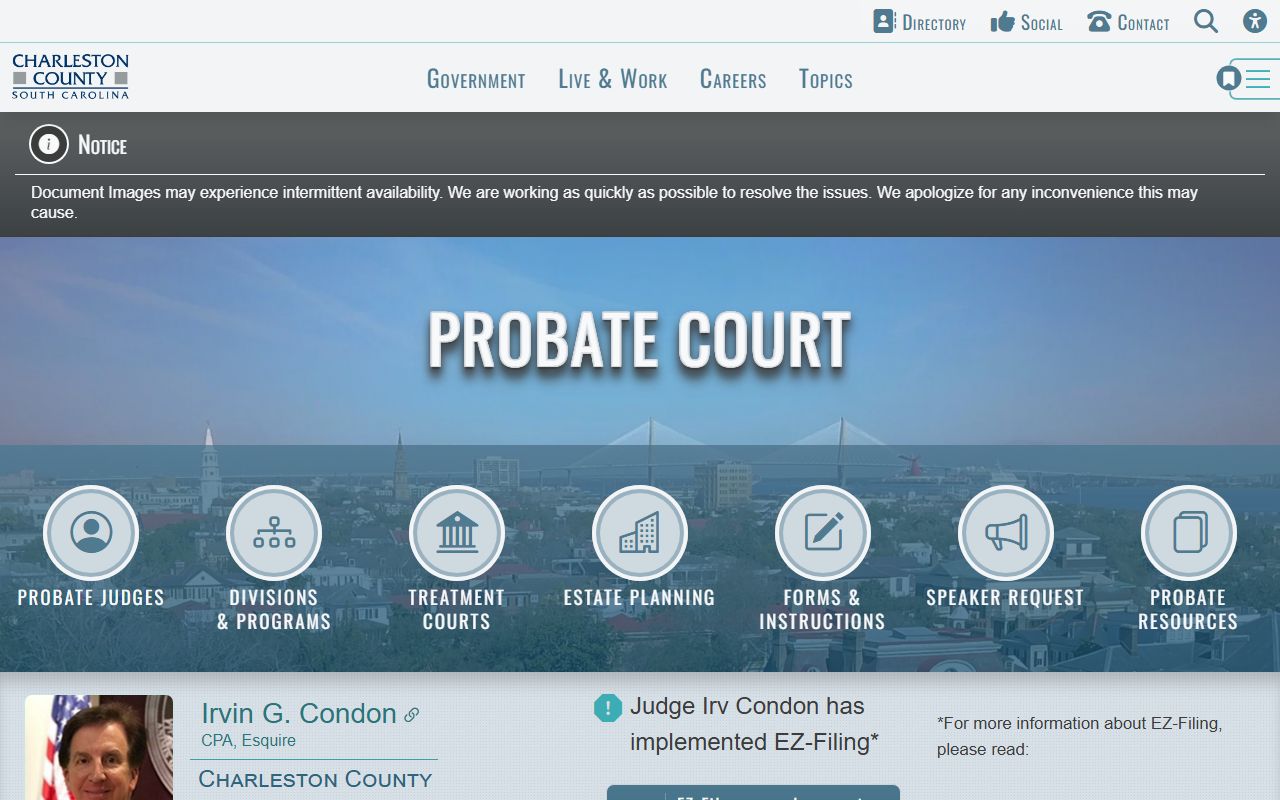
The Charleston County Probate Court website at charlestoncounty.org/departments/probate/ is the best source for current filing instructions, staff contacts, and updates on court operations.
| Court | Charleston County Probate Court |
|---|---|
| Address | 100 Broad Street, Suite 469, Charleston, SC 29401 |
| Phone | (843) 958-5180 |
| Fax | (843) 958-5191 |
| Hours | Monday-Friday 8:30 AM - 5:00 PM |
| Website | charlestoncounty.org/departments/probate/ |
History of Charleston County Probate Court Records
Charleston County has one of the oldest continuous probate records in the United States. The forerunner of today's Probate Court was the Court of the Ordinary, which was established when the Carolina Colony was founded in 1670. That court handled wills and estate matters from the very beginning of English settlement in the region. Copies of wills from 1671 through 1871 and estate inventories from 1687 through 1785 are now housed in the South Carolina Room of the Charleston County Main Library. The original documents are held at the South Carolina Department of Archives and History.
South Carolina's Constitution of 1868 replaced the Court of the Ordinary with the Probate Court. The 1895 Constitution made most probate courts dependent on the General Assembly for their funding and procedures. Charleston County was an exception. It remained a constitutional court until 1962, reflecting the unique legal and political status the city and county held in South Carolina for much of the state's history. Marriage license records in Charleston County date from 1879 to the present day.
This deep historical record makes Charleston County probate filings a rich source for genealogical and historical research. Families with roots in the Lowcountry region often find documents in the Charleston County probate record that do not exist anywhere else. The South Carolina State Library and the SC Department of Archives and History are important partners for researchers working with these older materials.
Note: Wills and estate records from 1671 to 1871 held in the Charleston County Main Library are copies. The originals are at the SC Department of Archives and History, which should be contacted if you need certified copies or need to verify the accuracy of a transcription.
Charleston County Probate Court Estate Division
The Estate Division of the Charleston County Probate Court opens approximately 2,200 estates per year and tries about 400 litigated cases annually. These numbers reflect the size and complexity of Charleston County, which includes one of the most populous and economically active areas in South Carolina. Estate administration begins when a personal representative files a petition with the court after a Charleston County resident dies.
If the deceased left a will, it is submitted to the court for validation. The court reviews the document and, if valid under South Carolina Title 62, admits it to probate and issues letters testamentary to the personal representative. The personal representative then uses those letters to access accounts, sell property, pay debts, and eventually distribute assets to beneficiaries. Every step in this process produces probate court records that become part of the estate file in Charleston County.
When no will exists, the estate is intestate. The court applies the succession rules of Title 62 to determine who inherits and appoints a personal representative to administer the estate. Intestate estates in Charleston County produce the same types of probate filings as testate estates. The difference is in the distribution scheme: intestate estates follow the statutory formula, while testate estates follow the instructions in the validated will.
The litigated case volume in the Estate Division reflects the court's role in resolving disputes about will validity, contested accountings, claims by creditors, and disagreements among heirs. These cases can produce substantial probate court records including pleadings, orders, and hearing transcripts in Charleston County.
Marriage Licenses and the Charleston County Probate Marriage Bureau
The Marriage Bureau at the Charleston County Probate Court issues roughly 5,000 marriage licenses per year, making it one of the busiest marriage license offices in South Carolina. Both applicants must appear in person. South Carolina requires both parties to be at least 18 years old to marry without parental consent. The license is valid for 30 days from the date of issue. After the ceremony, the officiant returns the signed license to the court where it is filed as a permanent probate record in Charleston County.
Marriage license records in Charleston County are public records. The court holds marriage license records from 1879 to the present. Certified copies can be obtained from the court directly. For older marriage records from before 1879, researchers should check the historical collections at the South Carolina State Library and the SC Department of Archives and History. VitalChek offers online ordering for South Carolina vital records and may be a convenient option for those who cannot visit the court in person.
Note: The high volume of marriage license applications at the Charleston County Probate Court means wait times can be significant, especially during peak wedding seasons. Calling ahead to confirm procedures before visiting is a practical step.
Charleston County Probate Court Commitment Division
The Commitment Division of the Charleston County Probate Court handles approximately 2,000 involuntary commitment proceedings each year. These proceedings address situations where an individual may be a danger to themselves or others due to a mental health condition or substance use disorder. The Probate Court has jurisdiction over these matters under South Carolina law. The commitment process involves a hearing before the Probate Judge, and the court records from these proceedings document the legal steps taken in each case.
Access to commitment records is more restricted than estate or marriage records due to the sensitive and personal nature of the information involved. Persons seeking access to commitment records in Charleston County should contact the Probate Court directly to understand the applicable access rules. The court's commitment to protecting individual rights is central to how this division operates.
The current Probate Judge has also implemented programs including a Mental Health Court, an Adult and Juvenile Drug Court Program, and a Veterans Treatment Program. These initiatives extend the court's reach into therapeutic and rehabilitative services beyond the traditional probate record. A partnership with Charleston School of Law also supports a senior assistance program serving older residents with legal needs connected to probate matters in Charleston County.
Charleston County Register of Deeds and Probate Connections
Charleston County has an elected Register of Deeds, meaning voters directly choose the official responsible for recording real property documents. This includes deeds, mortgages, plats, and other instruments affecting title to land in Charleston County. When a Charleston County estate includes real property, the personal representative must work with both the Probate Court to administer the estate and the Register of Deeds to record any deed that transfers property to heirs or buyers.
Estate-related deeds recorded at the Register of Deeds in Charleston County will typically reference the probate case, making it possible to cross-reference the two sets of records. Researchers tracking property through a Charleston County estate over multiple generations may find that property passed through several probate filings before reaching its current owner. The elected Register of Deeds provides direct accountability to Charleston County voters for the accuracy and accessibility of those property records.
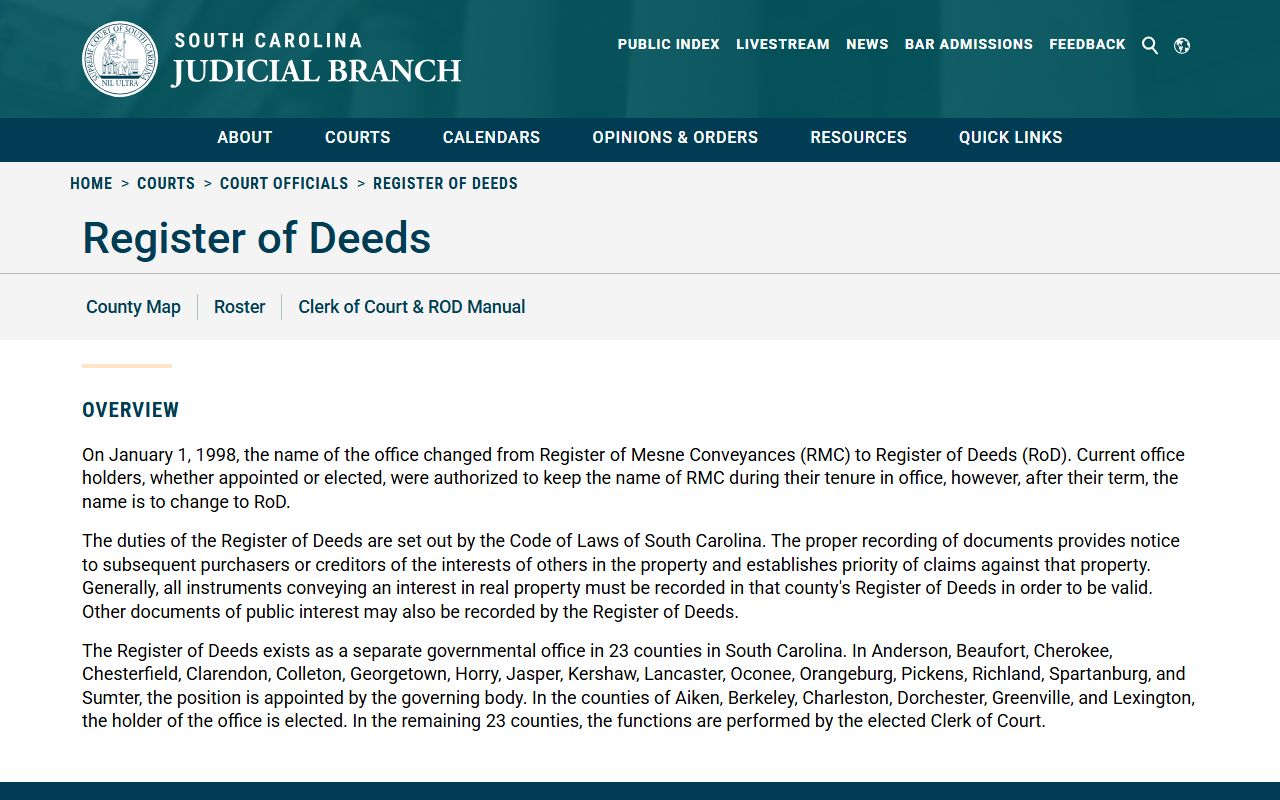
The combination of Charleston County Probate Court estate files and Register of Deeds property records provides the most complete picture of how assets moved through estates over time in one of South Carolina's most historically rich counties.
Accessing Historical Charleston County Probate Records
Charleston County holds one of the most extensive collections of historical probate records in the American South. Copies of wills from 1671 to 1871 and estate inventories from 1687 to 1785 are available through the South Carolina Room of the Charleston County Main Library. These documents span two centuries of colonial and antebellum history and are an irreplaceable resource for genealogical and historical research. The originals are preserved at the South Carolina Department of Archives and History.
The South Carolina State Library also holds materials relevant to Charleston County probate research, including digitized and microfilmed records from various periods. Researchers who cannot visit Charleston in person can often access some of these materials remotely through the State Library's services. The library can direct you to specialized collections and finding aids that help narrow a search through hundreds of years of Charleston County records.
The City of Charleston, one of the oldest cities in the United States, was founded in 1670 alongside the Carolina Colony. The city's long history means that probate records connected to Charleston families can span many generations and may intersect with some of the most significant events in American history.
Estate inventories from the 17th and 18th centuries in Charleston County can reveal extraordinary detail about daily life, property, and family relationships during those periods.
For the oldest Charleston County probate court records, contacting both the State Library and the SC Department of Archives and History gives you the best chance of locating original or transcribed copies of the documents you need.
Note: Researchers should be aware that historical Charleston County probate records reflect the legal and social conditions of their era, including records related to enslaved persons as property listed in estate inventories. The SC Department of Archives and History provides guidance on working with these materials responsibly.
Guardianship and Conservatorship Filings in Charleston County
The Charleston County Probate Court handles guardianships and conservatorships for incapacitated adults under the jurisdiction granted by South Carolina Title 62. A guardianship gives a court-appointed person authority over the personal decisions of an adult who can no longer manage their own care. A conservatorship gives authority over that person's financial affairs. Both arrangements require court approval and produce ongoing probate court records in Charleston County as the appointed guardian or conservator files required annual reports.
Petition forms for guardianship and conservatorship are available through the SC Judicial Branch forms page. The Charleston County Probate Court processes a significant number of these cases each year given the county's large and aging population. Families and attorneys filing these petitions in Charleston County should confirm current filing requirements and fees with the court before submitting documents.
The court also handles settlements for minors and wrongful death claims under its jurisdiction. These matters arise when a minor receives funds from a legal settlement or when a wrongful death claim is resolved. The Probate Court's approval ensures those funds are properly protected and managed. These proceedings generate their own category of probate court records in Charleston County separate from estate administration files.
Finding and Requesting Charleston County Probate Records
Most Charleston County probate court records can be accessed by contacting the court at 100 Broad Street or visiting in person during business hours. The court can search estate files, marriage license records, and other probate filings by name or case number. Staff can provide plain copies or certified copies depending on the type of document and the purpose of the request. Fees apply for copies, and in-person visits are the most efficient way to review complete files.
The South Carolina Judicial Branch public index allows online searches of court case information statewide. You can search for Charleston County probate cases by name or case number and see basic case details. For actual documents, a request to the court is required. The South Carolina General Assembly site has the full text of Title 62 and related statutes that govern what records must be kept and how they may be accessed in Charleston County.
For certified vital records including marriage certificates from Charleston County, VitalChek provides an online ordering service. The SC.gov portal connects you to multiple state agencies with holdings that complement what the Charleston County Probate Court maintains.
Cities in Charleston County
Charleston County includes several major cities. All probate matters for residents of Charleston County are handled by the Charleston County Probate Court at 100 Broad Street in downtown Charleston, regardless of which city the resident lives in.
Nearby Counties with Probate Court Records
Charleston County borders several South Carolina counties. Probate cases are filed in the county where the deceased resided at the time of death. If you are unsure which county applies, check county property tax records or voter registration to confirm the correct county of residence before filing.