
South Carolina Probate Court Records
South Carolina probate court records are public documents created when residents deal with estates, guardianships, marriage licenses, and related legal matters through the state's 46 county probate courts. These court documents cover everything from wills and estate administration filings to conservatorship proceedings and involuntary commitment orders. Whether you need records for a recent estate or historical probate filings dating back centuries, South Carolina gives you several ways to search, request, and obtain them from the county that holds them.
South Carolina Probate Court Records Quick Facts
How South Carolina Probate Courts Work
Every one of South Carolina's 46 counties has its own probate court. Residents elect a probate judge to a four-year term in each county. That judge has authority over a specific set of legal matters that affect families during the most significant moments of their lives. The South Carolina Judicial Branch oversees the Unified Judicial System, and the probate courts operate within that structure under Chief Justice John W. Kittredge, who took office on August 1, 2024.
Probate court jurisdiction in South Carolina covers marriage licenses, estates of deceased persons, guardianships and conservatorships of incapacitated adults, settlements for minors and wrongful death claims, and involuntary commitments of persons with mental illness or chemical dependency. These are not minor administrative tasks. Each area involves court documents that become part of the public record, accessible to anyone who knows where and how to look.
The governing law is Title 62 of the South Carolina Code, known as the South Carolina Probate Code. It contains eight articles that define how probate courts operate, how estates are administered, how wills are proven, and how vulnerable persons are protected. The South Carolina General Assembly creates and amends these statutes, and the code is kept current through each legislative session. Understanding Title 62 helps you know what rights you have when accessing or filing probate court records.
The South Carolina government portal connects citizens to all state agencies, including the courts. From there you can reach county-specific contact pages, look up court hours, and find the right office for your search.
What Probate Court Records Include
The South Carolina Judicial Branch maintains a case records search covering all 46 counties, and the range of probate filings you can find there is broad. Probate court documents touch nearly every major life event that involves a legal proceeding in this state.
The Judicial Branch website for Charleston County Probate Court reflects just how wide that range is. Estate records include last wills and testaments, petitions to open an estate, letters testamentary, inventory and appraisement filings, accountings, and orders of distribution. Guardianship and conservatorship files contain petitions, capacity evaluations, court orders appointing guardians, and annual reports that guardians must file with the court each year. Marriage license applications and the issued licenses themselves are probate records too, since each county probate court issues them directly. Commitment proceedings generate their own set of court documents, as do settlements for minors and wrongful death claims. Charleston County alone opens roughly 2,200 estates each year and issues around 5,000 marriage licenses annually, which gives you a sense of the volume of probate court records created statewide.
The Judicial Branch also maintains online trial court rosters and an E-Filing system. The Trial Court Virtual Portal extends that access further for parties who need to review filings without visiting a courthouse in person.
The South Carolina Judicial Branch site includes Spanish translation options, county-specific contact pages, and direct links to the case records search for all 46 counties.
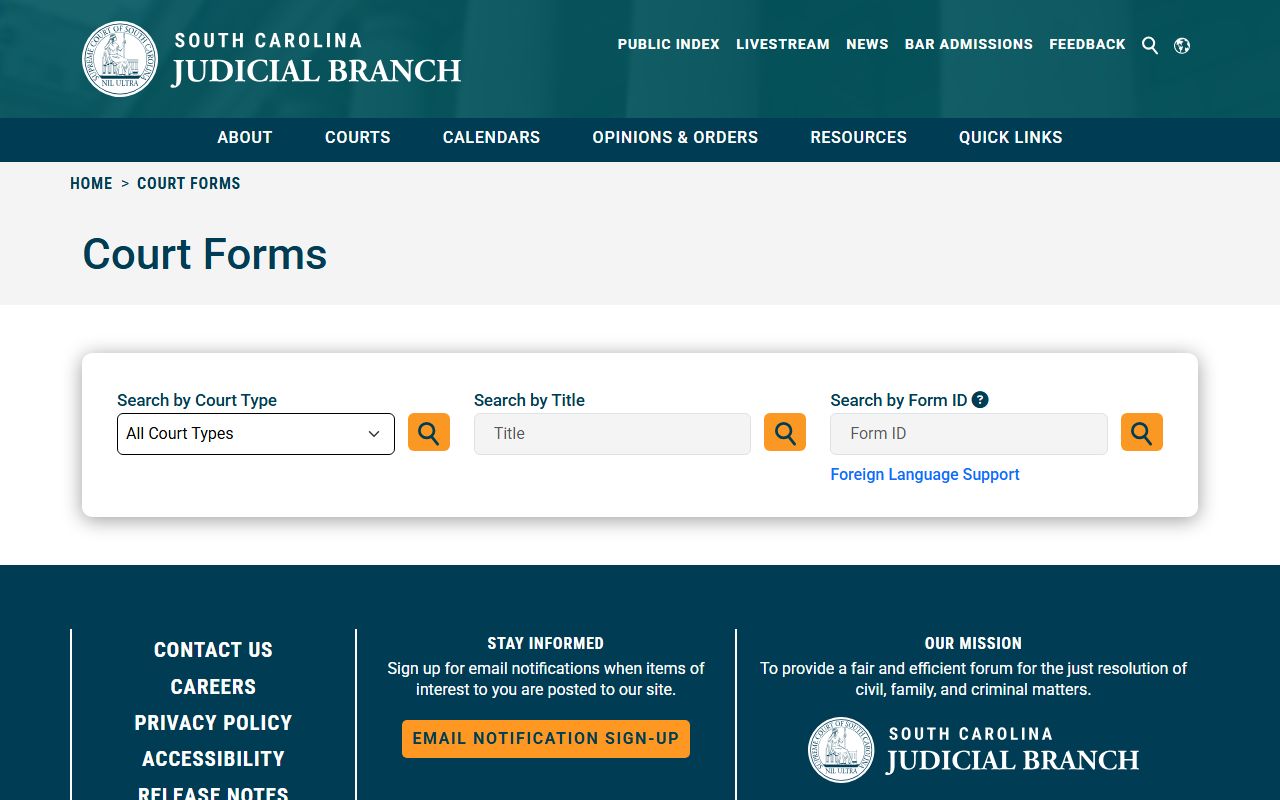
The Judicial Branch's online portal gives you a single starting point for locating probate court records in any of the state's 46 counties without having to track down each court individually.
Note: Not every record type is available online. Older filings may require an in-person visit or a written request to the county probate court that holds them.
Finding Probate Court Records in South Carolina
The South Carolina Judicial Branch provides an online case records search that covers probate court filings across the state. You can search by party name, case number, or case type. The Trial Court Virtual Portal extends that access for attorneys and parties who need to review filings without visiting a courthouse. Spanish translation options are available on the Judicial Branch site for residents who need them.
For records not yet digitized, or for certified copies of court documents, you visit the county probate court in person. Each of the 46 county courts keeps its own docket and filing system. Staff can assist you in locating estate records, wills, guardianship files, and other probate filings. Bring as much identifying information as you can: the full legal name of the deceased or the party involved, approximate dates, and any case numbers you already know. For Anderson County Probate Court and most other counties, walking in prepared saves significant time.
Some counties allow written or email requests for record copies. Processing times vary by county and by the age of the records involved. The South Carolina Court Forms Portal is searchable by court type, form title, and form ID, and it shows you exactly what forms are required for common transactions, which helps you prepare before you arrive at the courthouse.
The Greenville County Probate Court offers an online system called ACMS for attorneys who need to access case files remotely, at a cost of $15 per month or $150 per year. Similar arrangements exist in other larger counties. If you are an attorney or legal researcher who regularly works with South Carolina probate filings, check with each county to see what remote access options are available.
Estate Administration in South Carolina
The South Carolina Probate Code at Title 62 sets out the rules for estate administration in detail. When a person dies with a valid will, the executor named in that document must bring the original will and the death certificate to the probate court within 30 days of the death. The court admits the will to probate, reviews it, accepts it as legally valid, and then issues letters testamentary that give the executor authority to act on behalf of the estate.
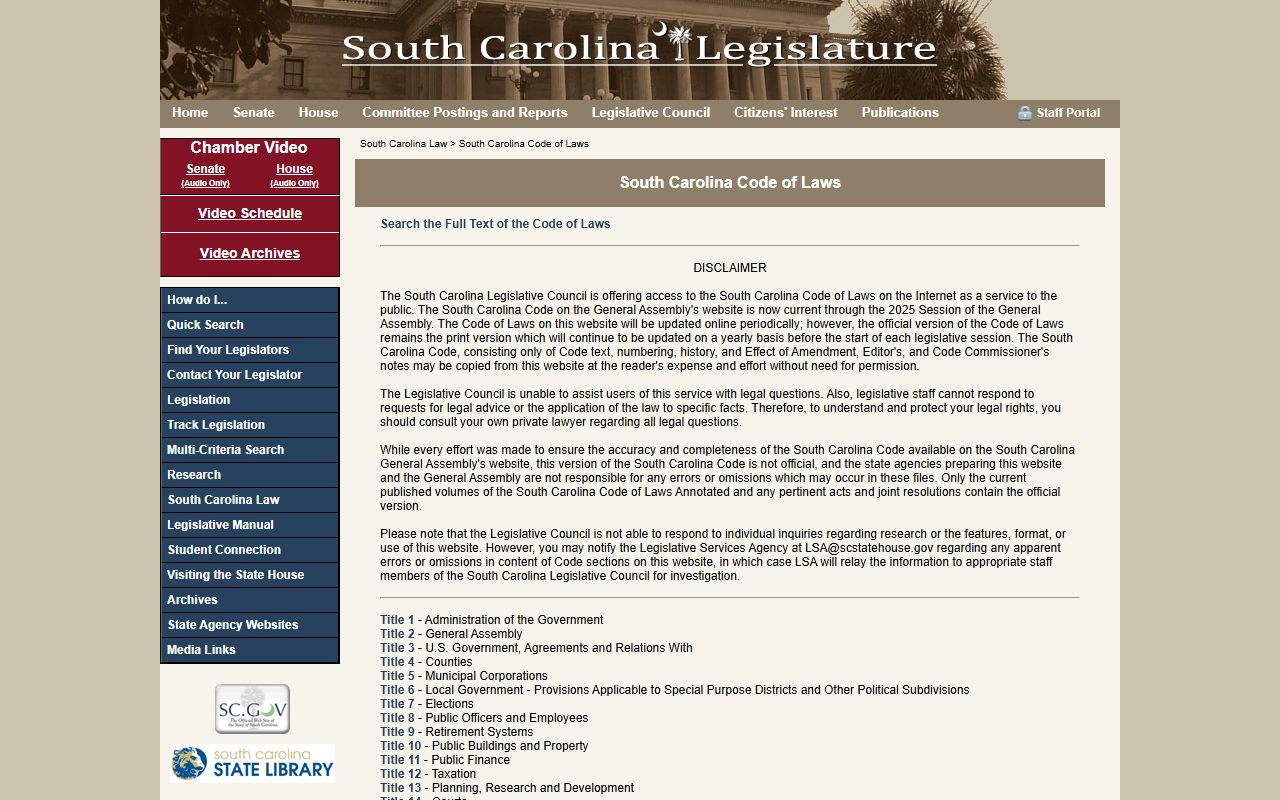
Article 2 of Title 62 governs intestate succession, which is what happens when someone dies without a will. The law then determines who inherits the estate and who may serve as personal representative. That person performs the same functions as an executor: gathering assets, paying debts, filing an inventory with the court, and distributing what remains to the rightful heirs according to the statutory order of succession. The personal representative is legally responsible for all court filings throughout the process.
Article 3 covers the probate of wills and the full administration process. Article 4 addresses foreign personal representatives and ancillary administration, which applies when a South Carolina resident dies with property in another state, or when an out-of-state decedent owned property here. These are complex situations, and the probate court records generated in those cases reflect that complexity. Charleston County alone handles around 400 litigated estate cases each year, meaning disputes that require a judge's ruling. Across all 46 counties, estate administration filings make up a substantial portion of total probate court records created annually.
Note: The personal representative bears legal responsibility for all court filings during estate administration. Errors or missed deadlines can significantly extend the process and may require additional court proceedings to correct.
Marriage Licenses Through Probate Court
In South Carolina, you apply for a marriage license at the probate court of the county where either applicant lives, or in any county if neither lives in the state. The South Carolina General Assembly has set the general rules for marriage licenses through statute, but each county court administers the process locally, and there are county-specific details that matter.
Requirements are consistent across counties at the baseline. Both applicants must be at least 18 years old and appear together at the court. You need valid identification that shows your legal name along with a Social Security card. Anderson County requires a 24-hour waiting period between application and issuance, and the $46 fee there is payable in cash only. Both parties must appear together. Beaufort County Probate Court, overseen by Probate Judge Heather R. Galvin and Associate Judge Lindsay A. Sutcliffe, now requires appointments for marriage license applications, available between 9 a.m. and 3 p.m. As of December 22, 2025, Beaufort County's satellite offices in Hilton Head Island and Bluffton accept estate filings by drop-off only and do not process marriage licenses.
Charleston County issues roughly 5,000 marriage licenses each year. Marriage license records are part of the public probate court record and can be searched through the county court or the statewide judicial case lookup system. These records matter not just to the couple but also to family researchers, genealogists, and anyone conducting background or estate research who needs to establish legal relationships.
Guardianship and Conservatorship Records
Article 5 of Title 62 governs the protection of persons under disability. When an adult can no longer manage their own personal affairs due to a physical or mental condition, a family member or other interested party can petition the probate court for guardianship. When the issue is managing finances and property rather than personal decisions, the court may appoint a conservator instead. Both proceedings generate substantial probate court records that remain part of the public file.
The petition must explain the nature of the person's incapacity. A medical evaluation or capacity assessment is typically submitted with the filing. The court may appoint a guardian ad litem to represent the allegedly incapacitated person's interests during the proceeding. After a hearing, the judge issues an order that either grants or denies the requested authority. Once a guardianship or conservatorship is in place, the appointed person must file annual reports with the probate court documenting their decisions and, in conservatorships, their handling of the ward's financial affairs. Those annual reports are part of the ongoing court record.
South Carolina defines a vulnerable adult in this context as a person who is 18 years of age or older and has a physical or mental condition that prevents them from providing for their own care or protection. Greenville County handles estates, adult guardianships and conservatorships, mediation, Health Care Power of Attorney filings, and Living Will declarations through its probate court. Those filings are distinct from estate records but are equally significant public documents. For involuntary commitments in Anderson County, the Mental Health Center at 200 McGee Road can be reached at 864-260-2220.
Note: Conservatorship annual reports are filed with the court and are generally accessible as part of the probate court record, though a court may restrict access to particularly sensitive financial or medical information in specific cases.
South Carolina Probate Court Forms
The South Carolina State Library has long supported access to government records and legal documents for residents across the state. For current probate court forms, the official source is the South Carolina Court Forms Portal, maintained by the Judicial Branch.
The forms portal is searchable by court type, form title, and form ID number. You can filter results to show only probate court forms. Available forms cover estate administration, petitions to open an estate, inventory and appraisement, accountings, and orders of distribution. Guardianship and conservatorship forms include petitions, annual reports, and court orders. Marriage license applications are listed there as well. Commitment proceeding forms round out the collection. Many forms are available in English, Portuguese, and Spanish, reflecting the state's diverse population.
The portal makes it practical for people to prepare the correct paperwork before visiting the courthouse, which reduces errors and speeds up filing. Whether you are opening an estate, seeking guardianship of a family member, or applying for a marriage license, the forms portal is the right place to start before you make the trip to your county probate court.
Historical Probate Records in South Carolina
South Carolina has some of the oldest probate records in the country. The colony was founded in 1670, and a forerunner court called the Court of the Ordinary began operating shortly after that date. The South Carolina Constitution of 1868 replaced the Court of the Ordinary with the modern Probate Court. That long history means the state holds centuries of estate papers, wills, and court proceedings that researchers and genealogists can access today.
The South Carolina State Library holds historical probate records dating to the colonial period. Its collections include estate papers, original wills, and records of court proceedings from across the state. The library's Notable State Documents Awards Program, active since 1991, has recognized important government publications and records. The library recently invested in a KASEMAKE CXD archival box machine that produces custom-fitted boxes to protect fragile original documents from further physical deterioration. That kind of preservation work keeps centuries-old records accessible for future researchers.
Charleston County's history is especially deep. Wills recorded between 1671 and 1871 are housed at the Charleston County Main Library. The original documents from that 200-year span are preserved at the South Carolina Department of Archives and History. For genealogists and family historians, these records are irreplaceable. They document property ownership, family relationships, debts, and the lives of people who would otherwise be largely invisible to history.
The complete index of the South Carolina Code covers 63 titles. Researchers looking into the legal framework for historical probate proceedings may find relevant material in Title 14 (Courts), Title 20 (Domestic Relations), Title 21 (Estates, Trusts, and Guardians), and Title 30 (Public Records), in addition to Title 62 (Probate Code).
South Carolina Register of Deeds
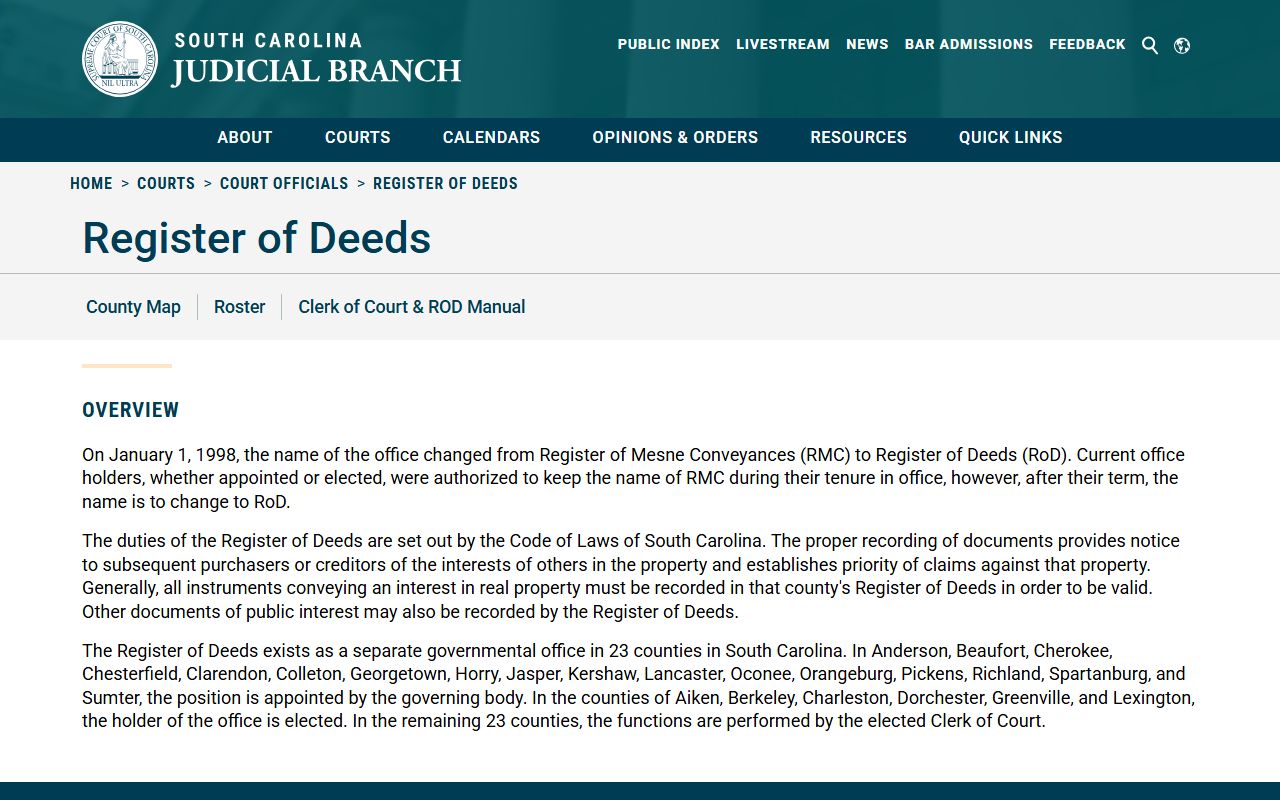
The South Carolina Register of Deeds office is closely connected to probate and estate matters. When a personal representative sells or transfers real property from a deceased person's estate, that deed gets recorded with the Register of Deeds in the county where the property sits. The RoD office took its current name on January 1, 1998, replacing the former Register of Mesne Conveyances designation.
The office exists as a separate entity in 23 of South Carolina's 46 counties. Six counties have an elected Register of Deeds: Aiken, Berkeley, Charleston, Dorchester, Greenville, and Lexington. Seventeen counties have an appointed Register of Deeds: Anderson, Beaufort, Cherokee, Chesterfield, Clarendon, Colleton, Georgetown, Horry, Jasper, Kershaw, Lancaster, Oconee, Orangeburg, Pickens, Richland, Spartanburg, and Sumter. In the remaining 23 counties, the Clerk of Court performs the Register of Deeds functions, so you would contact that office for deed and property transfer records connected to an estate.
When you are researching an estate, the Register of Deeds records can tell you what real property the decedent owned, what transfers occurred during administration, and whether any liens or encumbrances exist on the property. Cross-referencing RoD records with probate court filings gives you a more complete picture of the estate. Both sets of documents are public records accessible through the respective county offices. The South Carolina government portal can help you identify which office to contact in any given county.
Vital Records for Estate Administration
Before a probate court can open an estate, the personal representative must present a death certificate. That document is the starting point for the entire administration process. Obtaining certified copies quickly and reliably matters, especially given the 30-day window for presenting a will after death that applies in counties like Anderson.
The VitalChek platform serves as the official partner of South Carolina vital records offices and provides a secure way to order death certificates and other vital records online. VitalChek is PCI-compliant and uses LexisNexis identity validation to confirm the identity of the requester before processing the order. Records are printed and shipped directly from the government agency, not from a third-party fulfillment center. That means you receive an official certified copy that probate courts and other government offices will accept.
Death certificates are not the only vital records that matter in estate proceedings. Birth certificates may be needed to establish the identity of heirs, particularly when no will exists and intestate succession rules apply. Marriage and divorce records can affect inheritance rights, especially in blended families or when the decedent was married more than once. Having certified copies of all relevant vital records before you open the estate reduces delays and prevents the court from sending you back to gather documents you should have brought on your first visit.
Note: You will typically need multiple certified copies of a death certificate since banks, investment institutions, the probate court, and other agencies each require their own original certified copy and will not accept photocopies.
Browse Probate Court Records by County
Each of South Carolina's 46 counties maintains its own probate court with separate dockets, filing systems, and contact information. Select a county below to find guidance on accessing local probate court records including estate filings, guardianship cases, conservatorship proceedings, and marriage licenses.
Probate Records in Major South Carolina Cities
Probate court jurisdiction follows county lines in South Carolina, not city limits. Residents of any city obtain their probate court records from the county court that serves their area. The links below point to city-specific guides explaining which county court handles probate filings for that community, along with local office details and search guidance.