
York County South Carolina Probate Court Records
York County probate court records document all proceedings before the county's elected probate judge, including estate administration, wills, guardianships, conservatorships, marriage licenses, minor settlement approvals, wrongful death settlement approvals, and involuntary commitment hearings. York County anchors the northern edge of South Carolina, sharing a long border with North Carolina and sitting within the greater Charlotte metropolitan area. Its population has grown rapidly in recent years, driven by migration from other states, and the probate court regularly handles estates with assets in multiple jurisdictions. Heirs, title researchers, genealogists, and legal professionals rely on York County probate court records to confirm estate outcomes and trace how property has passed between generations in this fast-growing part of the state.
York County Quick Facts
York County Probate Court Authority and Title 62
The York County Probate Court operates under the South Carolina Probate Code, Title 62, which defines the court's jurisdiction and the procedures applicable to each type of proceeding. The probate judge is elected countywide to a four-year term by York County voters. The court is located at the county seat in the town of York, though residents in Rock Hill, Fort Mill, and other communities throughout the county have access to the same court.
The court has jurisdiction over the estates of all persons who were domiciled in York County at the time of death. It also handles adult guardianship proceedings, adult conservatorship proceedings, marriage license issuance, approval of settlements involving minors, wrongful death settlement approvals, and involuntary mental health commitment proceedings. Each case generates filings that are retained as permanent York County probate court records.
The South Carolina Judicial Branch maintains the Public Index, a free online tool covering case-level information for all 46 South Carolina counties. Searching by party name or case number returns York County probate proceedings. Copies of filed documents must be obtained from the York County Probate Court directly. The Public Index does not provide document images.
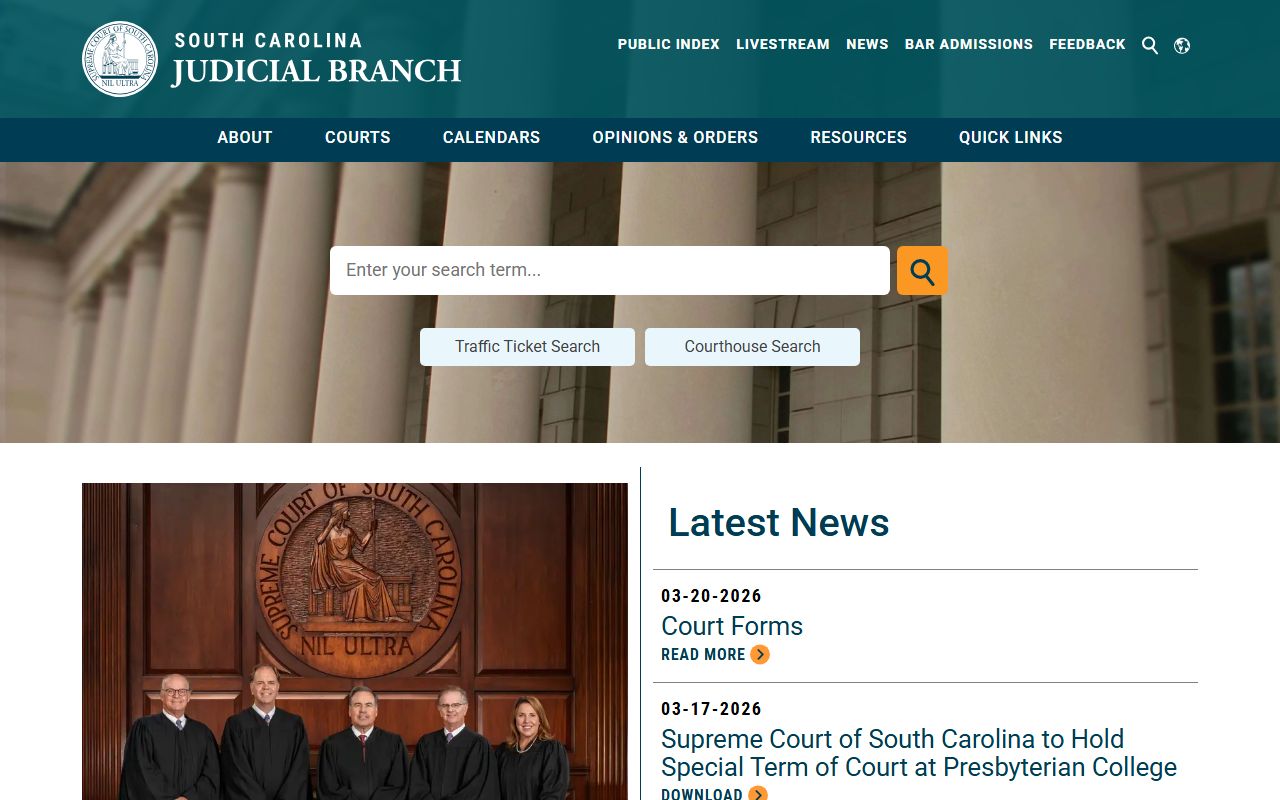
The SC Judicial Branch Public Index is the most efficient starting point for locating a York County probate case before contacting the courthouse directly.
What York County Probate Records Contain
Estate files represent the largest category of York County probate court records. A complete estate file contains the petition to open proceedings, the original will if one was left, a certified death certificate, a detailed inventory of the decedent's assets, all creditor claims and their outcomes, accountings from the personal representative, and the final order closing the estate. All of these documents are public records accessible to interested parties.
Guardianship and conservatorship case files form a significant portion of York County's probate records. A guardianship file documents the appointment of someone to make personal decisions for an adult who can no longer do so independently. It includes the petition, supporting medical or clinical evidence, the court's appointment order, and all annual reports thereafter. A conservatorship file covers the parallel appointment for financial management, with an initial asset inventory and annual accountings filed with the court each year. Both types of records are reviewed regularly by the York County Probate Court to ensure the appointed persons are meeting their statutory obligations.
Marriage license records issued by the York County Probate Court are retained in the court's files. They show both parties' names, dates of birth, and the issuance date. These records come up regularly in estate proceedings where a spousal relationship must be documented to establish an heir's right to inherit or to take under a will.
Note: Assets held in beneficiary-designated accounts, such as retirement accounts or life insurance policies, pass outside of probate and will not appear in the York County probate estate file regardless of how large those assets are.
Accessing York County Probate Court Records
Records are available in person at the York County Probate Court in the town of York. Staff can search by party name or case number and can retrieve both current active files and older archived records. Visitors should bring valid photo identification. The court's standard fee schedule applies to all copies. Certified copies carry a higher fee than plain copies and are required when official documentation is needed for legal proceedings or financial institutions.
The SC Judicial Branch Public Index provides free online access to case-level information for all York County probate proceedings. It is searchable by name and case number without an account. Document images are not available through the index. To obtain copies of specific documents, contact the York County Probate Court directly by phone, mail, or in-person visit. Blank forms for estate administration, guardianship, and conservatorship are available free through the SC Courts forms library. Always use the current approved versions to prevent filing rejections.
Vital records needed for York County probate proceedings can be ordered through VitalChek, the state-authorized online ordering service for South Carolina death certificates, birth certificates, and marriage records. Historical research into older York County estate records may be supported by collections at the South Carolina State Library, which holds materials covering the Piedmont and Upstate regions of the state.
Estate Administration Through the York County Probate Court
Administering an estate in York County begins with presenting the original will and an original certified death certificate to the probate court. Photocopies are not accepted at the opening stage. When the decedent died without a valid will, the South Carolina Probate Code governs who inherits and in what proportions under Title 62's intestate succession rules.
The court appoints a personal representative after reviewing the opening documents. This person, whether named as executor in a will or appointed as administrator in an intestate matter, has a legal duty to gather all estate assets, give proper notice to creditors, pay valid claims from estate funds, file an inventory and accountings with the York County Probate Court, and distribute the remaining estate to the proper heirs or beneficiaries. Every step in this process produces a filing that becomes part of the permanent York County probate estate record.
York County's rapid population growth means the probate court regularly handles estates with complex asset structures, including investment portfolios, business interests, vacation properties in North Carolina, and retirement accounts. For decedents who owned real estate in both York County and North Carolina, separate probate proceedings in the North Carolina county where the property sits may be required in addition to the York County estate proceeding. York County personal representatives with multistate estates should assess whether ancillary probate in another state is necessary early in the administration process.
Note: Small estates below the value threshold set by Title 62 may qualify for a simplified affidavit procedure that reduces the court involvement required to close the estate.
York County Guardianship and Conservatorship Filings
York County's growing and aging population generates a steady caseload of guardianship and conservatorship petitions. These proceedings are initiated when a family member or other interested party believes that a York County resident can no longer safely make personal decisions or manage finances on their own. The probate court reviews each petition carefully because the outcome limits the individual's legal autonomy.
A guardianship petition in York County must be supported by evidence of incapacity, typically medical records or clinical evaluations. The court schedules a hearing after the petition is filed and may appoint a guardian ad litem to represent the proposed ward's interests independently. If the court grants the petition, its order defines the guardian's specific authority and any conditions on how that authority may be exercised. The appointed guardian must then file annual reports with the York County Probate Court documenting the ward's health, living conditions, and general welfare. These reports are preserved as part of the ongoing guardianship record.
Conservatorship cases provide financial oversight through a parallel structure. After appointment, the conservator files an inventory of all assets under management and submits annual accountings that itemize every receipt and expenditure. The York County Probate Court reviews these filings and can investigate if accountings are late, incomplete, or show evidence of mismanagement. Any person with a legitimate interest in a York County conservatorship case may petition the court if concerns arise about how the appointed conservator is conducting the administration.
York County Elected Register of Deeds and Probate Connections
York County is one of only six South Carolina counties where the Register of Deeds is directly elected by voters rather than appointed. This means the Register answers directly to York County residents at the ballot box, providing a level of public accountability that does not exist in counties with appointed registers. The Register records all instruments affecting real property in York County, including deeds, mortgages, plats, and liens.
When a York County estate includes real property, the deed transferring that property to heirs or a buyer must be recorded with the Register of Deeds after the probate court closes the case. Researchers tracing the ownership history of York County real estate often need to cross-reference the probate estate file with the deed index at the Register of Deeds office. The South Carolina Register of Deeds resource page provides statewide context on recording requirements that applies in York County.
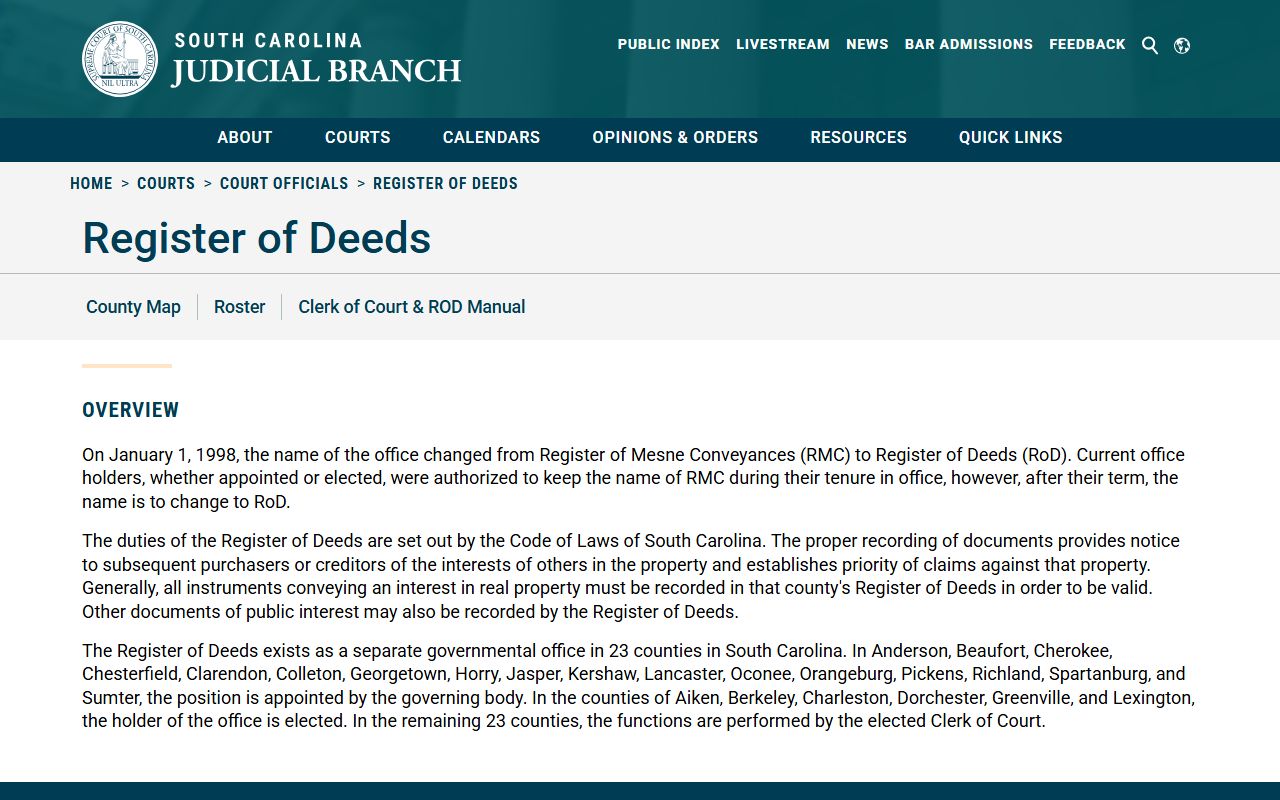
York County's elected Register of Deeds maintains the deed index that researchers must consult alongside the probate estate record to trace the full history of real estate transferred through York County estates.
Note: The elected Register of Deeds in York County is a separate office from the Clerk of Court, unlike in smaller counties where the Clerk performs both functions.
Fort Mill and Rock Hill Probate Considerations
The Town of Fort Mill is one of South Carolina's fastest-growing municipalities, with rapid residential development driven by families and individuals relocating from the Charlotte area. Fort Mill's new Town Hall was dedicated in February 2026, reflecting the scale of municipal investment that accompanies population growth. The town's growth has also brought a Traffic Enforcement Officer Program to address the increased demands of a larger community.
Fort Mill residents who are new to South Carolina are particularly likely to have assets in multiple states, including real estate or financial accounts in North Carolina, which sits just across the county line. When a Fort Mill resident dies owning property in North Carolina, a separate probate proceeding in the appropriate North Carolina county is required in addition to any York County estate proceeding. Families navigating this situation should confirm which assets are subject to South Carolina probate versus North Carolina probate before opening the estate.
Rock Hill is the largest city in York County and generates significant probate activity given its size and the diversity of its resident population. York County probate court records reflect estates from both longtime residents with deep family roots in the Piedmont and newer arrivals from other states who established their primary residence in the Rock Hill area.
Historical York County Probate Court Records
York County was established in 1785 as one of South Carolina's original counties following the reorganization of colonial districts. Its long history in the Piedmont region means the probate court holds records spanning more than two centuries of local estate activity. These historical records document the agricultural families, textile mill owners, and merchants who shaped York County's economic and social character across successive generations.
The South Carolina State Library maintains reference collections covering York County, including microfilmed court records and genealogical materials. Researchers studying older York County estates can supplement courthouse records with the library's holdings. The South Carolina Department of Archives and History is another key repository for records from the nineteenth and early twentieth centuries. Together, these sources allow genealogists and historians to trace York County families through estate filings across many generations.
Historical estate inventories from York County reflect the evolution of the local economy from antebellum agriculture through the textile era and into the modern growth period. These records offer a detailed and often vivid picture of what families owned, what debts they carried, and how property moved from one generation to the next in this part of South Carolina.
Cities in York County
York County includes two cities featured on this site: Rock Hill, the county's largest city, and Fort Mill, one of South Carolina's fastest-growing communities. Both cities are within the jurisdiction of the York County Probate Court in the town of York.
Nearby Counties
York County borders several South Carolina counties to the south and east. Each maintains its own probate court. The decedent's county of domicile at the time of death determines which court has jurisdiction over the estate.