
Sumter County South Carolina Probate Court Filings
Sumter County probate court records document all proceedings before the county's elected probate judge, including estate administration, wills, guardianship cases, conservatorships, marriage licenses, wrongful death settlement approvals, and involuntary commitment hearings. Sumter County sits at the crossroads of South Carolina's Pee Dee and Midlands regions, with the city of Sumter serving as both the county seat and the dominant population center. The county maintains an active military presence through Shaw Air Force Base, which adds a distinctive dimension to local estate and probate matters. Families, attorneys, and researchers depend on Sumter County probate court records to trace how estates were settled and how assets changed hands in this historically significant part of the state.
Sumter County Quick Facts
Sumter County Probate Court Jurisdiction
The Sumter County Probate Court derives its authority from the South Carolina Probate Code, Title 62, which defines the court's jurisdiction and the rules governing each type of proceeding. The probate judge is elected countywide to a four-year term by Sumter County voters. The court is located at the county seat in the city of Sumter and serves the entire county population.
The court has exclusive jurisdiction over the estates of persons who were domiciled in Sumter County at the time of death. It also handles adult guardianship proceedings, where a person loses capacity to make personal decisions; conservatorship proceedings, where a person loses capacity to manage finances; marriage license issuance; approval of settlements for minors receiving over ten thousand dollars; approval of wrongful death settlements; and involuntary mental health commitment proceedings. Each of these matters produces filings that become permanent Sumter County probate court records.
The South Carolina Judicial Branch operates the statewide Public Index, which provides free online access to case-level information. Searching by name or case number will return Sumter County probate cases. To obtain document copies, contact the Sumter County Probate Court directly. The Public Index does not display images of the filed documents themselves.
Note: When a Sumter County resident dies while on active military duty elsewhere, the estate is typically administered in the county where the individual was domiciled before service, which may or may not be Sumter County.
Types of Sumter County Probate Records
Estate records represent the highest volume of Sumter County probate court filings. A standard estate file holds the petition to open proceedings, the original will if one exists, a certified death certificate, an inventory of the decedent's assets, all creditor claims and their outcomes, accountings prepared by the personal representative, and the final order closing the estate. Each of these documents is part of the public record unless specifically sealed by court order.
Guardianship and conservatorship case files form another significant component of Sumter County probate records. A guardianship file contains the petition, medical or evaluative evidence of incapacity, any report prepared by a guardian ad litem, the court's appointment order, and all annual reports thereafter. A conservatorship file mirrors this structure but focuses on financial oversight, including asset inventories and annual accountings that document every transaction made on the protected person's behalf. These records are reviewed by the court on an ongoing basis to ensure the appointed persons are meeting their obligations.
Marriage license records issued by the Sumter County Probate Court are retained in the court's files and frequently come up in estate proceedings where a spousal relationship must be verified. These records show both parties' names, their dates of birth, and the date the license was issued and returned.
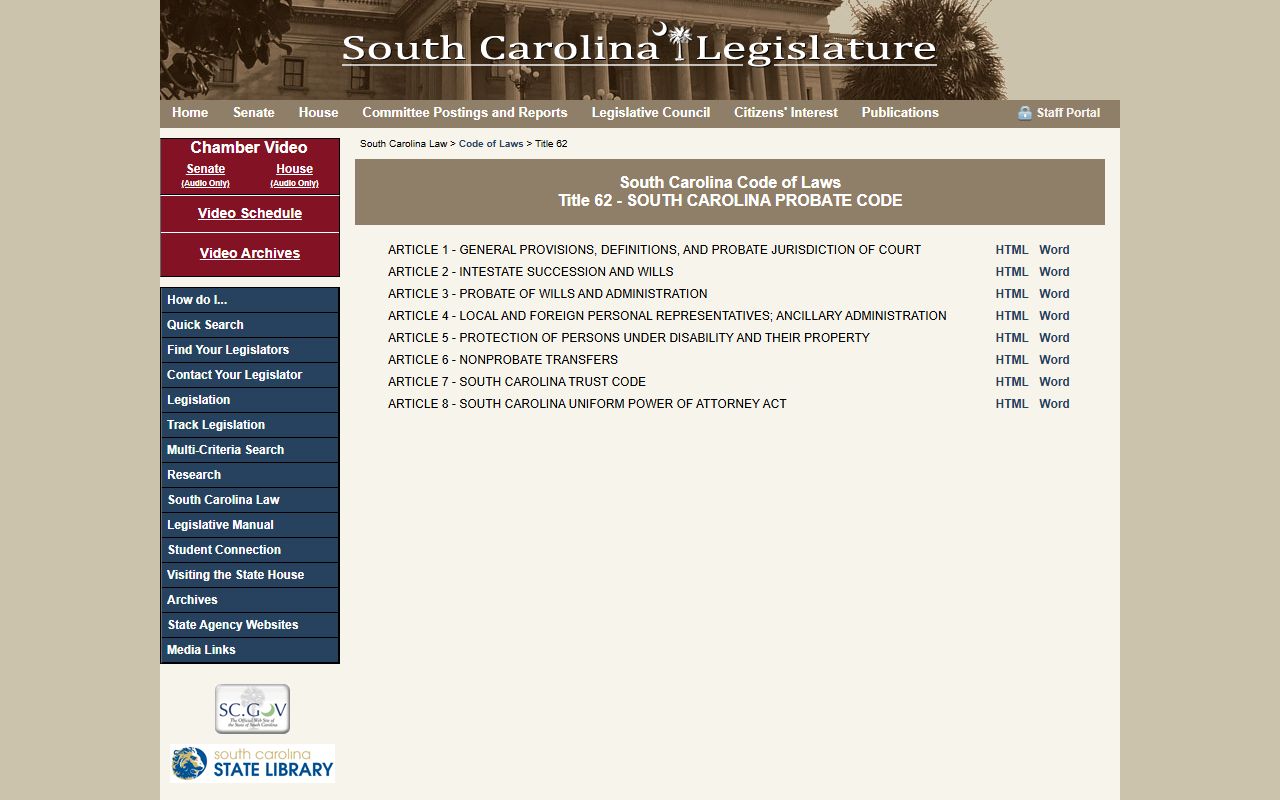
Title 62 of the South Carolina Code provides the complete legal framework for every category of proceeding handled by the Sumter County Probate Court.
Finding and Requesting Sumter County Probate Filings
In-person access to Sumter County probate court records is available at the probate court office in the city of Sumter. Staff can search by the name of the deceased or by case number and can retrieve both current and older archived files. Bring a valid government-issued photo ID. The standard fee schedule applies to all copies, and certified copies are priced higher than plain copies.
Online access is available through the SC Judicial Branch Public Index, which covers case-level information for all 46 South Carolina counties at no charge. The index does not include document images. Ordering the actual filed documents requires a written or in-person request to the Sumter County Probate Court. Forms for all common probate filings, including estate administration, guardianship petitions, and conservatorship petitions, are available free through the SC Courts forms library. Using the current approved versions prevents delays caused by outdated paperwork.
Vital records necessary for Sumter County probate proceedings can be ordered online through VitalChek, the state-authorized service for South Carolina death certificates, birth certificates, and marriage records. Historical research into older Sumter County probate filings may be supported by collections at the South Carolina State Library, which holds materials related to the Pee Dee and Midlands regions.
Administering an Estate in Sumter County Probate Court
Estate administration in Sumter County begins with presenting the original will and an original certified death certificate to the probate court. Neither document can be accepted in photocopy form at the opening stage. When the decedent left no valid will, Title 62 of the South Carolina Probate Code governs who may inherit the estate and in what proportions under the state's intestate succession rules.
Once the estate is open, the court appoints a personal representative. This person carries the legal duty to collect all of the decedent's property, give proper notice to creditors by publication and direct notice where required, pay valid claims from estate assets, file an inventory of all estate property with the Sumter County Probate Court, submit accountings that document the administration, and distribute the net estate to the correct heirs or beneficiaries. Each step generates a filing that becomes part of the permanent Sumter County probate record for that estate.
Sumter County's connection to Shaw Air Force Base means that some estates involve service members or veterans with benefits, life insurance, or retirement accounts that have beneficiary designations. Assets that pass by beneficiary designation do not go through probate and will not appear in Sumter County probate court records. The distinction between probate and non-probate assets is important for families trying to understand why certain assets are not included in the estate file.
Note: Small estates below the threshold set by Title 62 may qualify for a simplified affidavit procedure that does not require full court administration in Sumter County.
Sumter County Guardianship and Conservatorship Cases
The Sumter County Probate Court regularly handles guardianship and conservatorship petitions for county residents who can no longer manage their personal affairs or finances. These cases often involve elderly residents affected by dementia or other cognitive conditions, but they also arise when a younger adult suffers a serious injury or illness that impairs decision-making capacity.
A guardianship petition in Sumter County must describe the proposed ward's condition and explain why a guardianship is necessary. Medical evidence or a professional evaluation typically accompanies the petition. The court schedules a hearing and may appoint a guardian ad litem to independently assess the proposed ward's interests before the court rules. An approved guardianship order sets out the guardian's specific powers and any limitations. Afterward, the guardian must file annual reports with the Sumter County Probate Court covering the ward's health, living situation, and overall welfare. Those reports become part of the ongoing Sumter County probate guardianship record.
Conservatorship proceedings follow a parallel structure with financial accountability at the center. The conservator files an asset inventory and submits annual accountings that itemize every income receipt and every expenditure made on behalf of the protected person. The Sumter County Probate Court reviews these accountings and can take action if discrepancies appear or if the conservator fails to file on time. Interested parties who have concerns about how a conservatorship is being managed may file a motion or petition with the court.
Sumter County Register of Deeds and Estate Records
Sumter County has an appointed Register of Deeds who handles the recording of all instruments affecting real property in the county. When a Sumter County probate estate includes real property, the deed conveying that property to heirs or a purchaser must be recorded with the Register of Deeds after the probate court closes the case.
Researchers tracing the ownership history of Sumter County real property frequently find it necessary to cross-reference the probate estate file with the deed index at the Register of Deeds office. Together, these two sets of records document the full chain of title through estate transfers. The South Carolina Register of Deeds resource page provides statewide context on recording requirements that applies in Sumter County. The SC Judicial Branch site links to both the Public Index and supporting resources for records researchers.
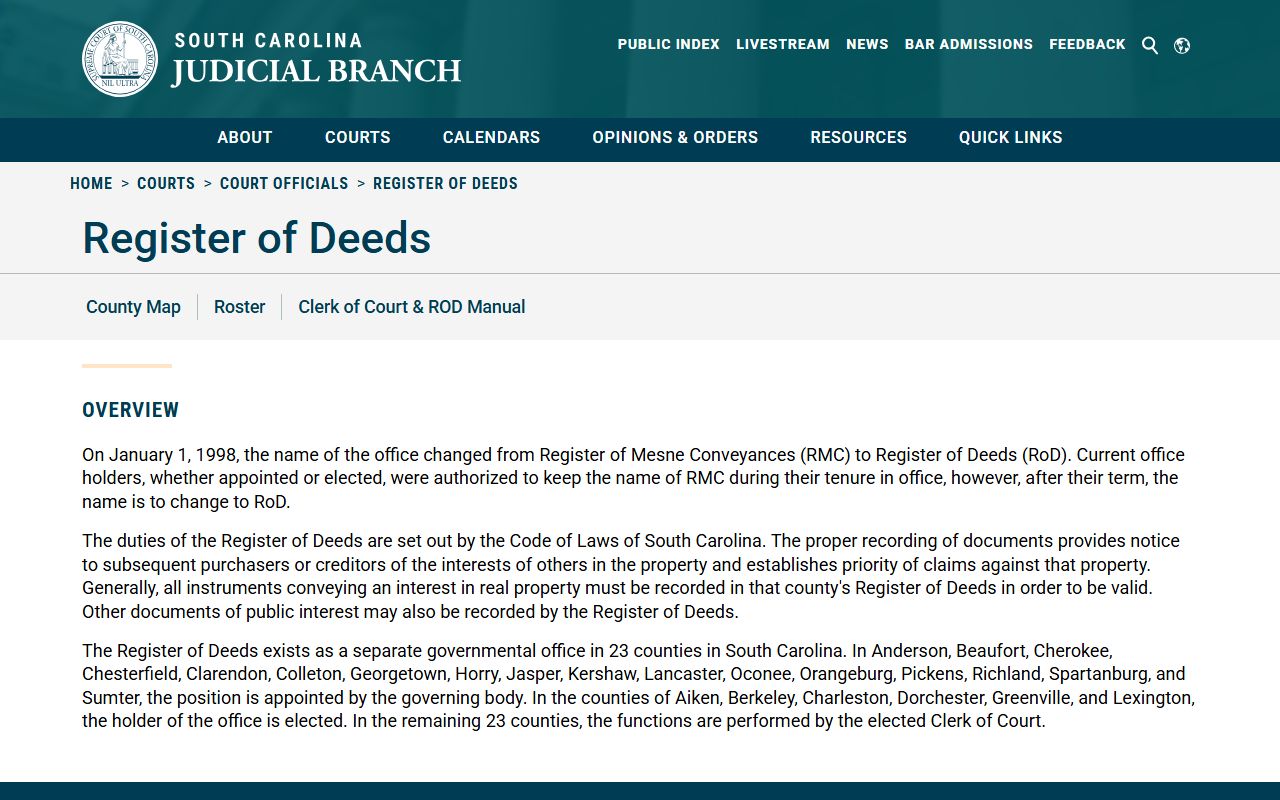
Combining the probate estate record with the Register of Deeds index gives researchers the most complete picture of how real property was transferred through estates in Sumter County.
Historical Sumter County Probate Court Records
Sumter County was established in 1785 as Claremont County and was renamed Sumter County in 1800, honoring General Thomas Sumter, a Revolutionary War hero known as the "Gamecock." Its long history means the probate court's records stretch back more than two centuries and contain detailed documentation of estate settlements involving some of South Carolina's most prominent families from the antebellum era through the present day.
The South Carolina State Library maintains historical collections covering Sumter County, including microfilmed and digitized court records from earlier generations. Genealogists researching families with deep roots in the county can supplement courthouse records with the library's holdings. The South Carolina Department of Archives and History is another key repository for records that predate modern courthouse systems. These combined sources allow researchers to trace estates and family relationships in Sumter County across many generations.
Historical Sumter County estate inventories from the nineteenth and early twentieth centuries provide detailed lists of real and personal property that illuminate local agricultural and commercial life. These records are valuable to historians, genealogists, and anyone researching the social and economic history of this part of South Carolina.
Note: Researchers looking for Sumter County probate records from before the county's formation in 1785 should search the records of the colonial districts that predated the county system in South Carolina.
Cities in Sumter County
The city of Sumter is the county seat and largest city in Sumter County. Residents of Sumter who have questions about probate matters should contact the Sumter County Probate Court located in the city.
Nearby Counties
Sumter County is bordered by several South Carolina counties in the Pee Dee and Midlands regions. Each county has its own probate court with jurisdiction over estates opened within its boundaries.